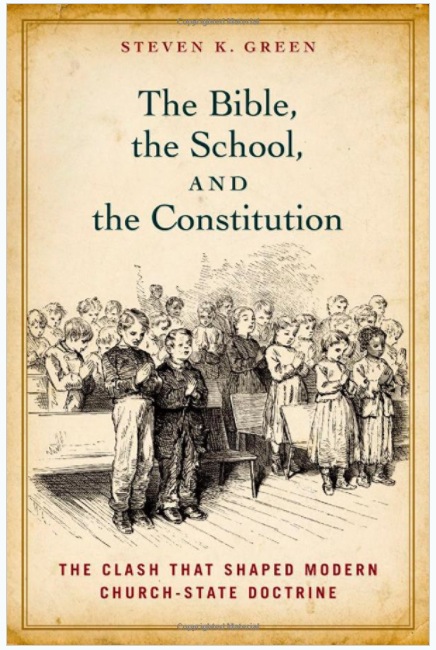
The Bible, the School, and the Constitution: The Clash that Shaped Modern Church-State Doctrine, by Steven K. Green, the Frank H. Paulus Professor of Law and director of the Center for Religion, Law and Democracy at Willamette University, has just been published by Oxford University Press. Here's the book description:
Read More >>
And the endorsements:Few constitutional issues have been as contentious in modern times as those concerning school prayer and the public funding of religious schools. But as Steven K. Green reveals in The Bible, the School, and the Constitution, this debate actually reached its apogee just after the Civil War, between 1863 and 1876. Green shows that controversy over Bible reading in public schools, commonly called "the School Question," captured national attention to an unprecedented degree.
Public education during the nineteenth century faced many competing pressures, including a widespread belief that schooling required a moral if not religious basis, a belief among many Protestants that Catholic immigration presented a threat to Protestant culture and to republican values, the need to accommodate increasing religious pluralism in the schools, and evolving understandings of constitutional principles. The School Question provided Americans with the opportunity to address and articulate these pressures, and to engage in a grand-and sometimes not so grand-public debate over the meaning of separation of church and state. Green demonstrates that the modern Supreme Court's decisions on school funding and Bible reading did not create new legal doctrines or abolish dominant practices, but built on legal concepts and educational trends that had been developing since the early nineteenth century. He also shows that while public reaction to a growing Catholic presence was a leading factor in this development, it was but one element in the rise of the legal doctrines the high court would embrace in the mid-twentieth century.
Rarely in the nation's history have people from such various walks of life-Protestants and Catholics, skeptics and theocrats, nativists and immigrants, educators and politicians-been able to participate in a national discussion over the meaning of a constitutional principle. The debates of this period laid the foundation for constitutional arguments that still rage today.
"This is a long overdue history of the origins of secular public education. Green's carefully researched discussion of the relationship between separation of church and state and public education is a powerful answer to scholars and jurists who have made ideologically-based and historically shaky arguments in favor of state supported religious exercise in the public schools. Green's work reminds us of the importance of Jefferson's notion of a 'wall of separation' between the state and religion."
---Paul Finkelman, President William McKinley Professor of Law and Public Policy, Albany Law School
"Steven K. Green has rapidly emerged as the leading historian of nineteenth-century church-state relations in America. Here he shows, in bold and brilliant colors, how the soaring debates over religion and education in the aftermath of the Civil War still shape our law and culture today, for better and worse. Deeply researched, smoothly written, and highly original, this book is a must-read for anyone who values religious liberty."
---John Witte, Jr., Director of the Center for the Study of Law and Religion, Emory University
"The Bible, the School, and the Constitution is an essential reinterpretation of the 'School Question' and its implications for church-state jurisprudence in American history. Repudiating recent accounts that attribute the emergence of 'secular' norms to anti-Catholic animus, Steven K. Green identifies a far more diverse set of motivations that converged to restrict religious practices in public schools along with public funding for religiously affiliated schools. In the process, Green implicitly defends these norms as constitutionally sound solutions for a diverse society."
--Tisa Wenger, author of We Have a Religion: The 1920s Pueblo Indian Dance Controversy and American Religious Freedom