Showing posts with label Scholarship -- Books. Show all posts

Colucci on McMahon on Nixon's Court

0 comments
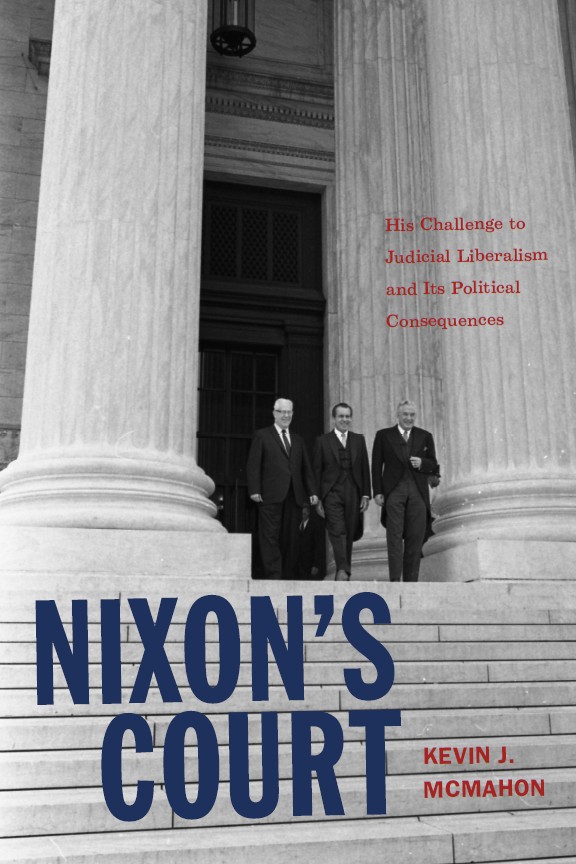
NIXON’S COURT: HIS CHALLENGE TO JUDICIAL LIBERALISM AND ITS POLITICAL CONSEQUENCES, by Kevin J. McMahon (Chicago: University of Chicago Press, 2011)  is reviewed by Frank J. Colucci, Department of History and Political Science, Purdue University Calumet on the Law and Politics Book Review.  Colucci begins:
In Nixon’s Court, presidential scholar Kevin J. McMahon offers a persuasive revisionist account of the judicial legacy of Richard Nixon. Critics argue that Nixon waged a jurisprudential “counter-revolution” against the Warren Court that eventually “failed” (Dworkin 1972; Blasi 1983). Using archival records, McMahon argues that the judicial nominations and legal actions Nixon undertook during his first term were driven by “politics far more than ideology” (p.6).

Rather than total revolt against the Warren Court, McMahon posits, Nixon engaged in a limited, opportunistic strategy. He publicly opposed judicial decisions in a few politically potent areas –busing for school desegregation and crime – and put political symbolism over ideology when selecting Supreme Court nominees. Nixon did this seeking to expand his Republican base with two components of the New Deal Democratic coalition: southerners and working-class, often Catholic voters in the urban North. But even in the areas of school desegregation and crime he made little attempt to overturn Warren-era precedents or to refuse to enforce Supreme Court’s decisions. He even benefitted from public perception and backlash against the Court. Based on his re-election in 1972 and later decisions concerning crime and busing, McMahon concludes, “on the issues Nixon most cared about” he essentially got what he wanted (p.252).

McMahon situates Nixon’s approach to the courts within the context of his narrow victory in 1968 and the re-election battle he expected in 1972. Facing Democrat Hubert H. Humphrey and the independent candidacy of Alabama Gov. George C. Wallace, Nixon needed to construct an electoral majority by adding disaffected Democrats without losing his GOP base. 

Read the rest here.
Read More >>

Green, The Bible, the School, and the Constitution

0 comments
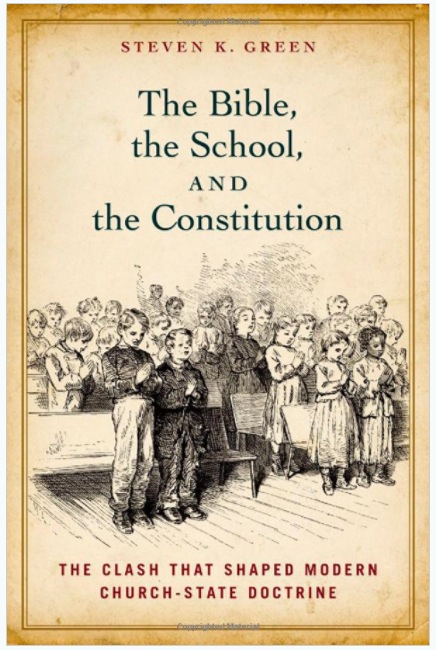
The Bible, the School, and the Constitution: The Clash that Shaped Modern Church-State Doctrine, by Steven K. Green, the Frank H. Paulus Professor of Law and director of the Center for Religion, Law and Democracy at Willamette University, has just been published by Oxford University Press.  Here's the book description:
Few constitutional issues have been as contentious in modern times as those concerning school prayer and the public funding of religious schools. But as Steven K. Green reveals in The Bible, the School, and the Constitution, this debate actually reached its apogee just after the Civil War, between 1863 and 1876. Green shows that controversy over Bible reading in public schools, commonly called "the School Question," captured national attention to an unprecedented degree.

Public education during the nineteenth century faced many competing pressures, including a widespread belief that schooling required a moral if not religious basis, a belief among many Protestants that Catholic immigration presented a threat to Protestant culture and to republican values, the need to accommodate increasing religious pluralism in the schools, and evolving understandings of constitutional principles. The School Question provided Americans with the opportunity to address and articulate these pressures, and to engage in a grand-and sometimes not so grand-public debate over the meaning of separation of church and state. Green demonstrates that the modern Supreme Court's decisions on school funding and Bible reading did not create new legal doctrines or abolish dominant practices, but built on legal concepts and educational trends that had been developing since the early nineteenth century. He also shows that while public reaction to a growing Catholic presence was a leading factor in this development, it was but one element in the rise of the legal doctrines the high court would embrace in the mid-twentieth century.

Rarely in the nation's history have people from such various walks of life-Protestants and Catholics, skeptics and theocrats, nativists and immigrants, educators and politicians-been able to participate in a national discussion over the meaning of a constitutional principle. The debates of this period laid the foundation for constitutional arguments that still rage today.
And the endorsements:
 "This is a long overdue history of the origins of secular public education. Green's carefully researched discussion of the relationship between separation of church and state and public education is a powerful answer to scholars and jurists who have made ideologically-based and historically shaky arguments in favor of state supported religious exercise in the public schools. Green's work reminds us of the importance of Jefferson's notion of a 'wall of separation' between the state and religion."
---Paul Finkelman, President William McKinley Professor of Law and Public Policy, Albany Law School

"Steven K. Green has rapidly emerged as the leading historian of nineteenth-century church-state relations in America. Here he shows, in bold and brilliant colors, how the soaring debates over religion and education in the aftermath of the Civil War still shape our law and culture today, for better and worse. Deeply researched, smoothly written, and highly original, this book is a must-read for anyone who values religious liberty."
---John Witte, Jr., Director of the Center for the Study of Law and Religion, Emory University

"The Bible, the School, and the Constitution is an essential reinterpretation of the 'School Question' and its implications for church-state jurisprudence in American history. Repudiating recent accounts that attribute the emergence of 'secular' norms to anti-Catholic animus, Steven K. Green identifies a far more diverse set of motivations that converged to restrict religious practices in public schools along with public funding for religiously affiliated schools. In the process, Green implicitly defends these norms as constitutionally sound solutions for a diverse society."
--Tisa Wenger, author of We Have a Religion: The 1920s Pueblo Indian Dance Controversy and American Religious Freedom
Read More >>

Wood Reviews White's Law in American History

0 comments
The eminent historian, Gordon Wood (Brown--history, emeritus), has published a review of Ted White's new book, Law in American History, Volume 1, in The New Republic. The review, entitled "The Dream of Law," is available online to subscribers.  Woods' review begins with high praise for White.  He is "one of America’s most eminent legal historians," having "written fifteen books, many of which have won awards and honors." Such a "wide-ranging body of legal scholarship," Woods writes, "has amply prepared White for what promises to be his magnum opus, a multi-volume work called Law in American History." 

Woods then proceeds to take issue with several features of White's first volume.  Woods criticizes, among other things, White's preoccupation with historical "contingency" and "issues of race, class, and gender."  Woods dismisses the series of hypotheticals posed in White's work as "counterfactual history with vengeance." And he questions White's failure to consider legal issues in the colonial period that, in Wood's estimation, are too important to ignore.  Moreover, Woods describes White's affirmation of readers' "different perspectives [on history], neither wrong or right," as "sad." Wood's review reflects profound differences of opinion among historians about what should count as history and about how historians should approach their craft.  For that reason, it is well worth a read.


Read More >>

Ted White Q&A: Law in American History in the Scholarly Market

0 comments
Ted White's most recent book, Law in American History, Volume I, is the point of departure for new questions for him about his work and how it fits with related scholarship.

Q: Although Law in American History, Volume I, makes unique contributions, you also cover some ground that has been covered by other works, particularly Lawrence Friedman's A History of American Law and Kermit Hall's The Magic Mirror. How would you describe the differences in approach between those volumes and yours? Did you (or the publisher) anticipate your volumes as "competitors" to those of Friedman and Hall?
 
A: When I first agreed to do a "history of American law," the scholarship I had produced at the time suggested that I would be unlikely to embrace the approach to law and legal institutions that had become influential among social historians in the 1960s and 1970s, which Lawrence Friedman famously described as law's containing "nothing autonomous," and being "a mirror of society." I believe that the publisher may have anticipated my producing a volume that was self-consciously "competitive" with Friedman's. But by the mid-1990s I had written Tort Law in America and The Marshall Court and Cultural Change, and I had come to the view that the relationship between law and its historical context was reciprocal and complex, and that neither conceiving of legal discourse as wholly "autonomous," nor thinking of legal developments as "mirroring" trends in the larger culture, were satisfactory ways of describing that relationship.

              The principal analytical move that I decided to make in this volume was to try to capture the complex reciprocal relationship between law and its historical context by centering my narrative first on themes that helped to centrally define American culture at periods in its history, and then to examine the way in which law interacted with those themes. I felt that by "taking history first and fitting law around it," so to speak, I would be able to emphasize that the defining characteristics of American law and legal institutions at any point in their history need to be historicized, and at the same time the central role of law in contributing to the major themes of American history needs to be understood.

And here is a related question.

Q: In general, you seem to have chosen to write on topics that have previously been covered a fair amount by other scholars--the Marshall Court, Earl Warren, Justice Oliver Wendell Holmes, sociological jurisprudence, legal realism, process theory, critical legal studies, and even Alger Hiss and baseball. Many historians seek to make a contribution by writing on something that hasn't been covered much in the literature. Was your choice to take up relatively familiar topics a conscious one?

A: That question is a fair way of describing my scholarly orientation. Although my work has sometimes resulted in my writing on quite obscure topics (western lands cases decided by the Supreme Court of the United States in the early nineteenth century or the internal deliberative protocols employed by the Supreme Court of the United States for much of its early history), I have generally been interested in trying to take a fresh look at topics that have been regularly studied because they have successively been deemed important (I am neither the first person nor the last to write on Earl Warren, Justice Oliver Wendell Holmes, the Marshall Court, or Alger Hiss). That has certainly been the case in this volume. Every one of my chapters takes up topics that numerous American historians have addressed, and some of them involve topics (American independence from the British Empire, the framing of the Constitution, slavery) that would be taken up in any survey of American history, including legal history. I am of the view that the continuing perceived importance of certain topics, or the lives of certain figures, means that they are attractive subjects for continuous scholarly reconsideration, and that such reconsideration is a way in which we try to make sense of our current experience.
Read More >>

Hibbitts reviews Hawke, Elite Competition and Written Law in Ancient Greece

0 comments
We have a backlog of H-Law reviews that we've been meaning to spotlight, starting with Bernard Hibbitts's review of Jason Hawke, Writing Authority: Elite Competition and Written Law in Early Greece (Northern Illinois University Press)

Here's an excerpt from the review:
Why did the Greeks start writing laws in the mid-seventh century BCE? Offering answers to this old chestnut of a question has become something of a cottage industry in the past few years . . . . Now comes Jason Hawke, an assistant professor in the History Department of Roanoake College, with his own take.
Specifically, Hawke
argu[es] that law-writing was actually a device used by elites to manage changing circumstances of competition among themselves in conditions where intra-elite social consensus founded on traditional values was coming apart under the influence of expanding population, commerce, and increasing social strife. Law-writing was not aimed primarily downward against the demos. Nor was it aimed upward against the elite. Instead it was part of lateral reordering of elite power relationships aimed at ensuring (however unsuccessfully, perhaps) that power was not overly concentrated in the hands of a few elite families or individuals.
Read more from Hibbitts (University of Pittsburgh School of Law) here.
Read More >>

Marshall reviews Farhang, "The Litigation State"

0 comments
The Law & Politics Book Review has released a review of The Litigation State: Public Regulation and Private Lawsuits in the United States (Princeton University Press), by political scientist Sean Farhang.

Reviewer Anna-Maria Marshall (University of Illinois, Urbana-Champaign) introduces the book as follows:
In his fascinating book, Sean Farhang asks a big question – what is the role of the civil litigation system in the American regulatory state? Politicians from both ends of the ideological spectrum frequently bemoan the fact that the United States is a litigious society, but in those debates, they rarely admit that private lawsuits are sometimes the only way for people to claim the rights granted to them by law. Other political systems relegate law enforcement primarily to command and control agencies, yet American skepticism about bureaucracy and regulation renders such enforcement regimes politically controversial. Thus, in many realms of regulation, Congress makes ordinary citizens “private attorneys general,” authorizing them to implement the law when and where they see fit. Farhang’s analysis seeks to explain the institutional context that gives rise to these enforcement mechanisms.
Read on here.
Read More >>

"Flagrant Conduct," "Cosmic Constitutional Theory," and More: This Week in the Book Pages

0 comments
A must-read item this week is David Oshinky's review, for the New York Times, of Flagrant Conduct: The Story of Lawrence v. Texas: How a Bedroom Arrest Decriminalized Gay Americans (W. W. Norton & Co.), by law professor Dale Carpenter. Oshinsky describes the book as "a stirring and richly detailed account of Lawrence v. Texas," which "turns conventional wisdom about Lawrence on its head." The rest is here.

Also reviewed in the NYT:
  • Cosmic Constitutional Theory: Why Americans Are Losing Their Inalienable Right to Self-Governance (Oxford University Press), by the Honorable J. Harvie Wilkinson III . Reviewer Jeffrey Rosen characterizes the book, here, as at once "modest," "invaluable," "unusual," and "inspiring." "For law students and citizens who are frustrated with the way that all the constitutional methodologies fail, in practice, to deliver on their promise of helping judges separate their political views and judicial decisions, Wilkinson’s primer offers a diagnosis of the problem and a self-effacing solution."
A second item that I highly recommend comes from the book pages of the Nation, where Alice Kaplan adapts material from her new book Dreaming in French: The Paris Years of Jacqueline Bouvier Kennedy, Susan Sontag, and Angela Davis (University of Chicago Press). Here's a taste:
[A] phenomenon as powerful and versatile as the American romance with France has played a vital role in Davis’s story, as it has for women as radically different as Jacqueline Bouvier and Susan Sontag. All three were transformed by studying in France in such a way that they would, in turn, transform the cultural and political life of the United States.
Read on here.

This week in the New Republic: The Book: a favorable review of Autumn in the Heavenly Kingdom: China, the West and the Epic Story of the Taiping Civil War (Alfred A. Knopf), an "engrossing new book" by Stephen R. Platt (mentioned in our Feb. 12 round-up, here), and a much less favorable review of The Swing Vote: The Untapped Power of Independents (St. Martin’s), by Linda Killian (the book "adds nothing of value to our understanding of independents in general and of swing voters in particular").

The Wall Street Journal covers Fatal Self-Deception: Slaveholding Paternalism in the South (Cambridge University Press), by Eugene D. Genovese and Elizabeth Fox-Genovese. "Taken together [with The Mind of the Master Class (2005) and Slavery in White and Black (2008)]," writes reviewer Fergus Bordewich, "the books represent a magisterial effort to place proslavery thought and sentiment within the realm of serious intellectual history. Avoiding polemics, the authors generally portray slave owners as honorable, pious and emotionally entangled with their human property to the point of self-delusion."

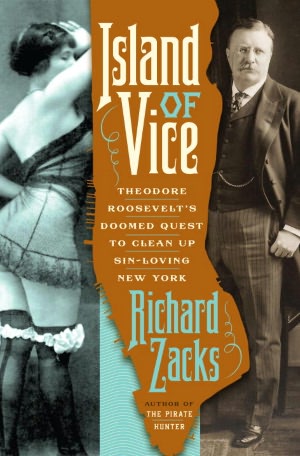
Also reviewed in the WSJ: David Dorsen's Henry Friendly: Greatest Judge of His Era (Harvard University Press) (here), which we mentioned just the other day (here); Island of Vice: Theodore Roosevelt's Doomed Quest to Clean Up Sin-Loving New York (Doubleday), by Richard Zacks (here); Rogues and Redeemers: When Politics Was King in Irish Boston (Crown), by Gerard O'Neill (here); and Reagan and Thatcher: The Difficult Relationship (W. W. Norton & Co.), by Richard Aldous (here).

A new issue of the London Review of Books is out. It covers modern British art, Greek democracy, Medieval grammar, French children, Hollywood rebels, and much more.


Last, we predicted that this book would grab headlines, and it has: the Los Angeles Times reviews (here) Tinderbox: How the West Sparked the AIDS Epidemic and the How the World Can Finally Overcome It (Penguin Press), by Craig Timberg and Daniel Halperin. More, from NPR, is here.


Read More >>

New Release: Ghachem, "The Old Regime and the Haitian Revolution"

0 comments
Malick W. Ghachem, University of Maine School of Law, has just published The Old Regime and the Haitian Revolution, with Cambridge University Press.  Here is the publisher's description:
The Haitian Revolution (1789–1804) was an epochal event that galvanized slaves and terrified planters throughout the Atlantic world. Rather than view this tumultuous period solely as a radical rupture with slavery, Malick W. Ghachem's innovative study shows that emancipation in Haiti was also a long-term product of its colonial legal history.  The key to this interpretation lies in the Code Noir, the law that regulated master-slave relations in the French empire.  The Code's rules for the freeing and punishment of slaves were at the center of intense eighteenth-century debates over the threats that masters -- not just freedmen and slaves -- posed to the plantation order.  Ghachem takes us deep into this volatile colonial past, digging beyond the letter of the law and vividly re-enacting such episodes as the extraordinary prosecution of a master for torturing and killing his slaves. This book brings us face-to-face with the revolutionary invocation of Old Regime law by administrators seeking stability, but also by free people of color and slaves demanding citizenship and an end to brutality. The result is a subtle yet dramatic portrait of the strategic stakes of colonial governance in the land that would become Haiti.
 And here are the blurbs:

"This book will have a major impact on our understanding of the single most important turning point in the history of New World slavery. A revolutionary study of revolution, this beautifully written and deeply researched work shows that the 'rupture narrative' has obscured critical aspects of continuity and the ways in which laws governing master-slave relations provided a changing framework for action in the slaves' quest for freedom."
-- David Brion Davis, Sterling Professor of History Emeritus and Director Emeritus of Yale's Gilder Lehrman Center for the Study of Slavery, Resistance, and Abolition

"The Old Regime and the Haitian Revolution offers a sweeping and lucid analysis of the making and unmaking of slavery and colonial law in Haiti. Ghachem brings together insightful analysis of juridical and political debates with riveting stories of how the enslaved and free people of Saint-Domingue sought to use law in pursuit of liberty. This brilliantly crafted book is a vital contribution to our understanding of law, empire, and revolution in the French Atlantic."

-- Laurent Dubois, author of Haiti: The Aftershocks of History

"Malick Ghachem's new book is a major contribution to our understanding of colonial Saint-Domingue and the Haitian Revolution. Ghachem argues that reforms meant to limit the abuses of slavery did more to weaken the institution than the criticisms of abolitionists, and he points out surprising continuities between the colonial regime and the new laws laid down by Toussaint Louverture and his successors. No one interested in the struggle against slavery during the revolutionary era can ignore his contribution."

-- Jeremy D. Popkin, T. Marshall Hahn, Jr, Professor of History, University of Kentucky
Read More >>

McDougall's "Bigamy and Christian Identity in Late Medieval Champagne"

0 comments
Sara McDougall, a historian at the John Jay College of Criminal Justice, City University of New York, has just published Bigamy and Christian Identity in Late Medieval Champagne with the University of Pennsylvania Press, which writes:
The institution of marriage is commonly thought to have fallen into crisis in late medieval northern France. While prior scholarship has identified the pervasiveness of clandestine marriage as the cause, Sara McDougall contends that the pressure came overwhelmingly from the prevalence of remarriage in violation of the Christian ban on divorce, a practice we might call "bigamy." Throughout the fifteenth century in Christian Europe, husbands and wives married to absent or distant spouses found new spouses to wed. In the church courts of northern France, many of the individuals so married were criminally prosecuted.

In Bigamy and Christian Identity in Late Medieval Champagne, McDougall traces the history of this conflict in the diocese of Troyes and places it in the larger context of Christian theology and culture. Multiple marriage was both inevitable and repugnant in a Christian world that forbade divorce and associated bigamy with the unchristian practices of Islam or Judaism. The prevalence of bigamy might seem to suggest a failure of Christianization in late medieval northern France, but careful study of the sources shows otherwise: Clergy and laity alike valued marriage highly. Indeed, some members of the laity placed such a high value on the institution that they were willing to risk criminal punishment by entering into illegal remarriage. The risk was great: the Bishop of Troyes's judicial court prosecuted bigamy with unprecedented severity, although this prosecution broke down along gender lines. The court treated male bigamy, and only male bigamy, as a grave crime, while female bigamy was almost completely excluded from harsh punishment. As this suggests, the Church was primarily concerned with imposing a high standard on men as heads of Christian households, responsible for their own behavior and also that of their wives.
“This is an excellent book,” blurbs Shannon McSheffrey of Concordia University.  “McDougall makes a persuasive argument that understanding the prosecution of bigamy in fifteenth-century Troyes entails some fairly radical changes in how we see late medieval marriage and the place of Christianity in late medieval culture.”
Read More >>

Mayeri on Hartog, "Someday All This Will Be Yours"

0 comments
Writing for Jotwell, Serena Mayeri (University of Pennsylvania) has reviewed Someday All This Will Be Yours: A History of Inheritance and Old Age (Harvard University Press, 2012), by Hendrik Hartog. Here's the first paragraph:
Modern medicine, the rise of the welfare state, and profound cultural shifts have transformed old age in the industrialized world. Or have they? Hendrik Hartog’s history of inheritance disputes from 1850 to 1950 excavates a world both familiar and foreign.  Then, older people who dreaded loneliness and destitution promised generous bequests of property in exchange for care and solicitude from younger adults. In turn, younger adults sacrificed opportunities—independence, mobility, marriage, fortune-seeking—to remain close to home and to provide arduous and intimate care in the hope of recompense, often in the form of real estate.
Read on here.
Read More >>
Copyright © MASS GOOD BUSINESS