Showing posts with label Scholarship -- Articles and essays. Show all posts

Bach, "Mobilization and Poverty Law"

0 comments
image credit
New from Wendy Bach (University of Tennessee College of Law): "Mobilization and Poverty Law: Searching for Participatory Democracy Amongst the Ashes of the War on Poverty." Here's the abstract:
In 1964, at the height of the Civil Rights Movement, the federal government launched Community Action, a program that was to be designed and implemented with the maximum feasible participation of the poor. Today in governance theory, we are told once again that participation by affected communities in the mechanisms of governance have the ability to deepen democracy – to yield better policy and to engage new voices in the mechanisms of democracy. Enclosed for your review is Mobilization and Poverty Law: Searching for Participatory Democracy Amongst the Ashes of The War on Poverty, an article that turns to history to explore a question central to both governance theory and community lawyering: Do the participatory democracy mechanisms of new governance theory have the ability, or can they be wielded by advocates and poor communities, to render poverty more responsive to community needs? To answer this question, Mobilization and Poverty Law provides a detailed chronicle of the creation and implementation of Community Action and maximum feasible participation and highlights the extraordinary story of its implementation in Durham, North Carolina. The article offers a definition against which to measure whether participation was “robust” and concludes that three factors were crucial in realizing robust participation: 1. the existence of the statutory participatory mandate; 2. the flexibility wielded by administrators in implementing the mandate; and 3. the choice by the agency to fund autonomous, community-controlled groups as a mechanism to realize robust participation. The article ends with two primary conclusions, one directed at new governance and the second directed at those invested in community lawyering. For new governance, the history suggests that participatory structures, as currently constituted, are likely to lead to little more than tokenism. For advocates committed to support the efforts of communities to build and wield political power, however, the article offers a more hopeful suggestion. Embracing what Scott Cummings has termed “constrained legalism,” the article suggests that advocates might take a page from history and, like our predecessors, seek to create, out of the tokenistic nods to participatory governance in current policy, programs and structures that might yield both robust participation and poverty policy that, in the eyes of poor communities, actually meets their needs. 
Hat tip: Poverty Law
Read More >>

Snyder and Barrett on Rehnquist's Lost Letter

0 comments
Brad Snyder, University of Wisconsin Law School, and John Q. Barrett, St. John's University School of Law, have posted Rehnquist's Missing Letter: A Former Law Clerk's 1955 Thoughts on Justice Jackson and Brown, which will appear in the Boston College Law Review 53 (2012).  Here is the abstract:    
"I think that Plessy v. Ferguson was right and should be reaffirmed." That's what Supreme Court law clerk William H. Rehnquist wrote privately in December 1952 to his boss, Justice Robert H. Jackson. When the memorandum was made public in 1971 and Rehnquist's Supreme Court confirmation hung in the balance, he claimed that the memorandum reflected Jackson's views, not Rehnquist's. Rehnquist was confirmed, but his explanation triggered charges that he had lied and smeared the memory of one of the Court's most revered justices. This Essay analyzes a newly discovered document, a letter Rehnquist wrote to Justice Felix Frankfurter in 1955, criticizing Jackson, that reveals what Rehnquist thought about Jackson shortly after Brown and the Justice's death. The 1955 letter was not known during Rehnquist's 1971 or 1986 confirmation hearings. It is also currently missing and may have been stolen from Frankfurter's Papers at the Library of Congress. This Essay argues that Rehnquist's 1955 letter represents his disappointment with Brown and the beginning of his outspoken criticism of the Warren Court. The letter, this Essay contends, says less about how Rehnquist felt about Jackson and more about Rehnquist's disappointment over his Justice's role in the most important Supreme Court decision of the twentieth century.
Update: Adam Liptak's column in the New York Times on the Snyder-Barrett find is here.
Read More >>

Nelson, "A Critical Guide to Erie . . ."

0 comments
Caleb Nelson, University of Virginia School of Law, has posted A Critical Guide to Erie Railroad Co. v. Tompkins, which appears in William & Mary Law Review 54 (2012). Here is the abstract:
Library of Congress
This paper--part of William & Mary's recent symposium on "Law Without a Lawmaker"-- tries to provide a concise but comprehensive analysis of Justice Brandeis's various arguments in Erie. Consistent with much of the new learning about Erie, the paper concludes that Justice Brandeis's historical argument is wrong, that his constitutional argument is highly suspect, and that even his practical arguments are less clear-cut than he suggested. The paper does not claim that anything in written federal law FORECLOSES the conclusion that Justice Brandeis reached in Erie. But the paper argues that nothing in written federal law COMPELS that conclusion either. Ironically, the Erie doctrine probably is best characterized as what modern lawyers call "federal common law."
Hat tip: Legal Theory Blog
Read More >>

Bowers and Carpenter on The Story of Lyng v. Northwest Indian Cemetery Protective Association

0 comments
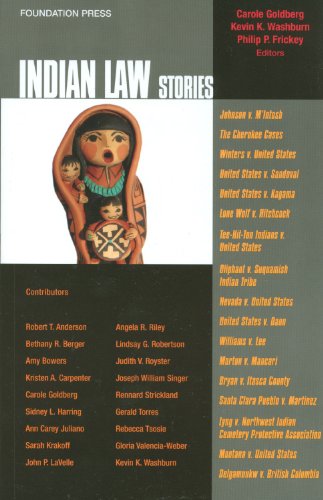
Challenging the Narrative of Conquest: The Story of Lyng v. Northwest Indian Cemetery Protective Association has just been posted on SSRN by Amy Bowers and Kristen A. Carpenter, University of Colorado Law School.  It appears in INDIAN LAW STORIES, Carole Goldberg, Kevin K. Washburn, Philip P. Frickey, eds., Foundation Press, 2011.  Here's the abstract:
In Lyng v. Northwest Indian Cemetery Protection Association (1988), the Supreme Court held that it would not violate the Free Exercise Clause for the U.S. Forest Service to build a road through the “High Country,” an area that is sacred to Yurok, Karuk, and Tolowa Indians living in Northern California and Southern Oregon. Unable to show “coercion” of their religious beliefs, the Indian plaintiffs could not rely on the First Amendment to protect their interests in aboriginal territory now owned by the United States. As Justice O’Connor wrote: ‘‘Whatever rights the Indians may have to the use of the area, those rights do not divest the Government of its right to use what is, after all, its land.’’ Scholars have criticized the case as narrowing individual Free Exercise rights and expanding the government’s property rights, to the detriment of religious freedoms. While Lyng deserves this notoriety, an exclusive focus on defects in the holdings obscures other important dimensions of the case. In particular, the Supreme Court’s opinion comes close to silencing altogether the Indians’ perspective on their sacred High Country. Law and religion scholarship, with few exceptions, also ignores tribal voices both on the religious practices and advocacy strategies that were so key to the Lyng case and its aftermath. Indeed, the Forest Service road was never built and the tribes continue to practice their religions in the High Country.

This article offers a tribally-centered version of Lyng, one that is rarely told, at least outside of tribal communities. Based on interviews with tribal members who participated in the case, as well as interdisciplinary research into the anthropology and religion literature, this is a story of cultural revival fueled by the Indian way of life. It is a story of a community forced to defend itself against the assimilationist agenda of the federal government — and developing a contemporary political identity in the process. It is a story of the inextricable relationship between Indian people and lands, in which the Tribes’ attachment to their sacred sites ultimately triumphed over the Supreme Court’s narrow application of religion and property laws. In the final analysis, we argue, the Indian story of religious and cultural persistence has prevailed over Lyng’s ostensible narrative of conquest. Today, as Lyng’s doctrinal legacy threatens to undermine advances made under the Religious Freedom Restoration Act of 1993, the broader story told here is potentially revealing for everyone concerned with religious liberties in the United States.
Read More >>

Theory and Method in Legal History: A Symposium

0 comments
Via Al Brophy at the Faculty Lounge, we've learned of the UC Irvine Law Review's recent symposium issue on Theory and Method in Legal History. The collection of legal historians represented here is truly extraordinary. Here are the articles, cribbed directly from Al's post:
Catherine L. Fisk and Robert W. Gordon, Foreword: “Law As . . .”: Theory and Method in Legal History

Steven Wilf, Law/Text/Past
Laura F. Edwards,The Peace: The Meaning and Production of Law in the Post-Revolutionary United States
Kunal M. Parker, Law “In” and “As” History: The Common Law in the American Polity 1790‒1900 
Roger Berkowitz, From Justice to Justification: An Alternative Genealogy of Positive Law
Marianne Constable, Law as Claim to Justice: Legal History and Legal Speech Acts
Christopher W. Schmidt, Conceptions of Law in the Civil Rights Movement
Norman W. Spaulding, The Historical Consciousness of the Resistant Subject
Barbara Young Welke, Owning Hazard, A Tragedy
Peter Goodrich, Specters of Law: Why the History of the Legal Spectacle Has Not Been Written
Shai J. Lavi, Enchanting a Disenchanted Law: On Jewish Ritual and Secular History in Nineteenth-Century Germany
Assaf Likhovski, Chasing Ghosts: On Writing Cultural Histories of Tax Law
John Fabian Witt, The Dismal History of the Laws of War
Paul Frymer, Building an American Empire: Territorial Expansion in the Antebellum Era 
Mariana Valverde, “The Honour of the Crown is at Stake”: Aboriginal Land Claims Litigation and the Epistemology of Sovereignty
Roy Kreitner, Money in the 1890s: The Circulation of Politics, Economics, and Law
Ritu Birla, Law as Economy: Convention, Corporation, Currency
Christopher Tomlins and John Comaroff, “Law As . . .”: Theory and Practice in Legal History
Read More >>
Copyright © MASS GOOD BUSINESS