Showing posts with label Courts and judges. Show all posts

Colucci on McMahon on Nixon's Court

0 comments
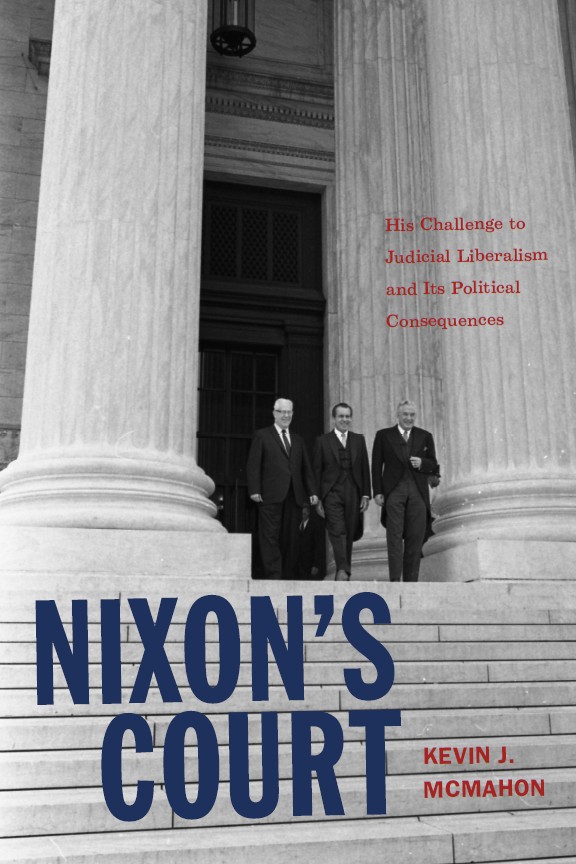
NIXON’S COURT: HIS CHALLENGE TO JUDICIAL LIBERALISM AND ITS POLITICAL CONSEQUENCES, by Kevin J. McMahon (Chicago: University of Chicago Press, 2011)  is reviewed by Frank J. Colucci, Department of History and Political Science, Purdue University Calumet on the Law and Politics Book Review.  Colucci begins:
In Nixon’s Court, presidential scholar Kevin J. McMahon offers a persuasive revisionist account of the judicial legacy of Richard Nixon. Critics argue that Nixon waged a jurisprudential “counter-revolution” against the Warren Court that eventually “failed” (Dworkin 1972; Blasi 1983). Using archival records, McMahon argues that the judicial nominations and legal actions Nixon undertook during his first term were driven by “politics far more than ideology” (p.6).

Rather than total revolt against the Warren Court, McMahon posits, Nixon engaged in a limited, opportunistic strategy. He publicly opposed judicial decisions in a few politically potent areas –busing for school desegregation and crime – and put political symbolism over ideology when selecting Supreme Court nominees. Nixon did this seeking to expand his Republican base with two components of the New Deal Democratic coalition: southerners and working-class, often Catholic voters in the urban North. But even in the areas of school desegregation and crime he made little attempt to overturn Warren-era precedents or to refuse to enforce Supreme Court’s decisions. He even benefitted from public perception and backlash against the Court. Based on his re-election in 1972 and later decisions concerning crime and busing, McMahon concludes, “on the issues Nixon most cared about” he essentially got what he wanted (p.252).

McMahon situates Nixon’s approach to the courts within the context of his narrow victory in 1968 and the re-election battle he expected in 1972. Facing Democrat Hubert H. Humphrey and the independent candidacy of Alabama Gov. George C. Wallace, Nixon needed to construct an electoral majority by adding disaffected Democrats without losing his GOP base. 

Read the rest here.
Read More >>

Snyder and Barrett on Rehnquist's Lost Letter

0 comments
Brad Snyder, University of Wisconsin Law School, and John Q. Barrett, St. John's University School of Law, have posted Rehnquist's Missing Letter: A Former Law Clerk's 1955 Thoughts on Justice Jackson and Brown, which will appear in the Boston College Law Review 53 (2012).  Here is the abstract:    
"I think that Plessy v. Ferguson was right and should be reaffirmed." That's what Supreme Court law clerk William H. Rehnquist wrote privately in December 1952 to his boss, Justice Robert H. Jackson. When the memorandum was made public in 1971 and Rehnquist's Supreme Court confirmation hung in the balance, he claimed that the memorandum reflected Jackson's views, not Rehnquist's. Rehnquist was confirmed, but his explanation triggered charges that he had lied and smeared the memory of one of the Court's most revered justices. This Essay analyzes a newly discovered document, a letter Rehnquist wrote to Justice Felix Frankfurter in 1955, criticizing Jackson, that reveals what Rehnquist thought about Jackson shortly after Brown and the Justice's death. The 1955 letter was not known during Rehnquist's 1971 or 1986 confirmation hearings. It is also currently missing and may have been stolen from Frankfurter's Papers at the Library of Congress. This Essay argues that Rehnquist's 1955 letter represents his disappointment with Brown and the beginning of his outspoken criticism of the Warren Court. The letter, this Essay contends, says less about how Rehnquist felt about Jackson and more about Rehnquist's disappointment over his Justice's role in the most important Supreme Court decision of the twentieth century.
Update: Adam Liptak's column in the New York Times on the Snyder-Barrett find is here.
Read More >>

Nelson, "A Critical Guide to Erie . . ."

0 comments
Caleb Nelson, University of Virginia School of Law, has posted A Critical Guide to Erie Railroad Co. v. Tompkins, which appears in William & Mary Law Review 54 (2012). Here is the abstract:
Library of Congress
This paper--part of William & Mary's recent symposium on "Law Without a Lawmaker"-- tries to provide a concise but comprehensive analysis of Justice Brandeis's various arguments in Erie. Consistent with much of the new learning about Erie, the paper concludes that Justice Brandeis's historical argument is wrong, that his constitutional argument is highly suspect, and that even his practical arguments are less clear-cut than he suggested. The paper does not claim that anything in written federal law FORECLOSES the conclusion that Justice Brandeis reached in Erie. But the paper argues that nothing in written federal law COMPELS that conclusion either. Ironically, the Erie doctrine probably is best characterized as what modern lawyers call "federal common law."
Hat tip: Legal Theory Blog
Read More >>
Copyright © MASS GOOD BUSINESS